The second movement of the Phantom of Utopia trilogy delves into a liminal dimension, a fragile threshold where reality begins to dissolve and the imagined has yet to fully emerge. Inspired by Tao Yuan-ming’s The Peach Blossom Spring, this piece evokes a dreamlike state in which time bends and perception falters, conjuring a mirage of utopia amid uncertainty.
Opening with granular synthesis, the sonic texture unfolds like a fractured mirror: each shard reflecting fragments of a world neither entirely real nor entirely imagined. These shimmering sounds inhabit a limbo: dense with pixelated noise, yet weightless, like whispers suspended in space.
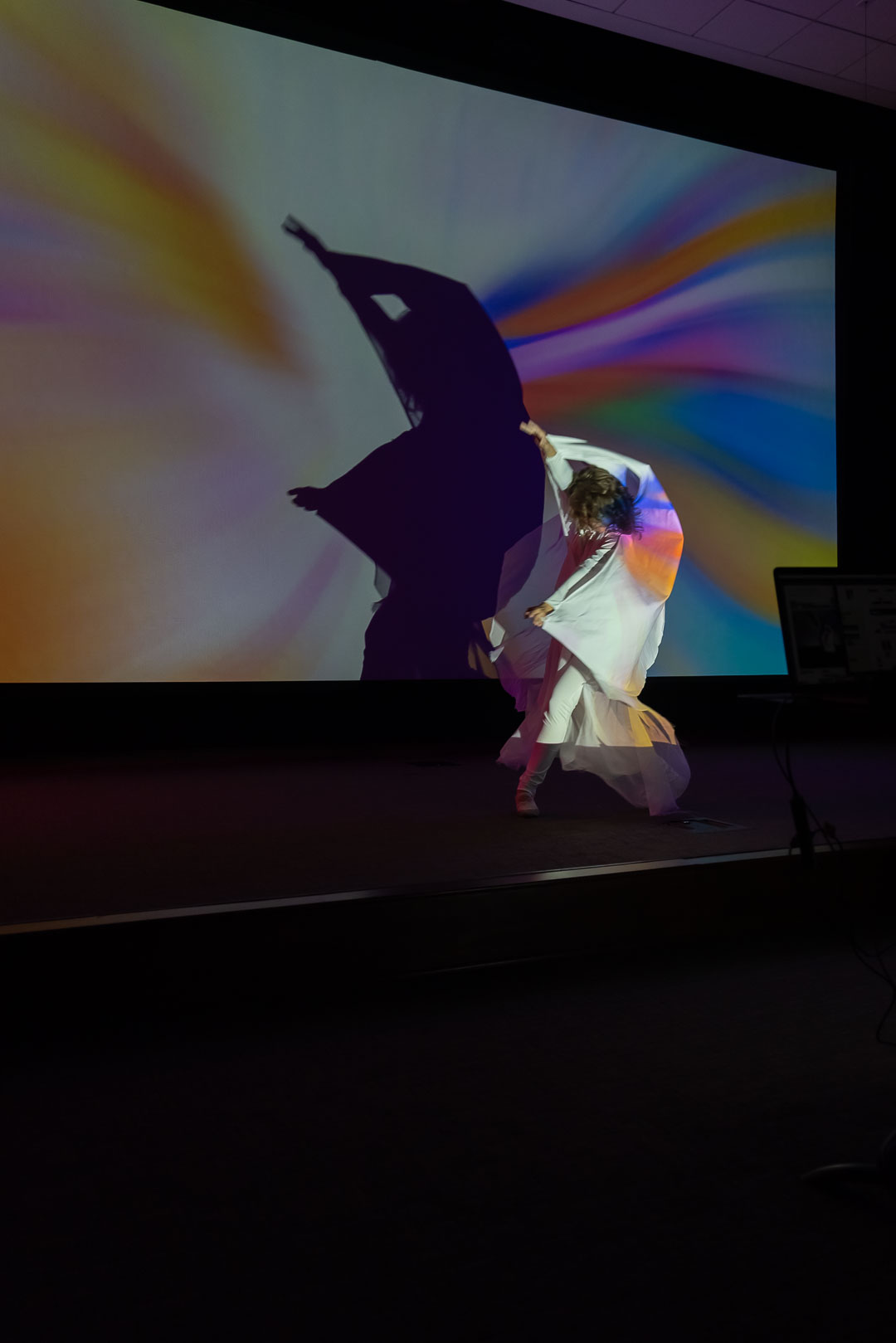
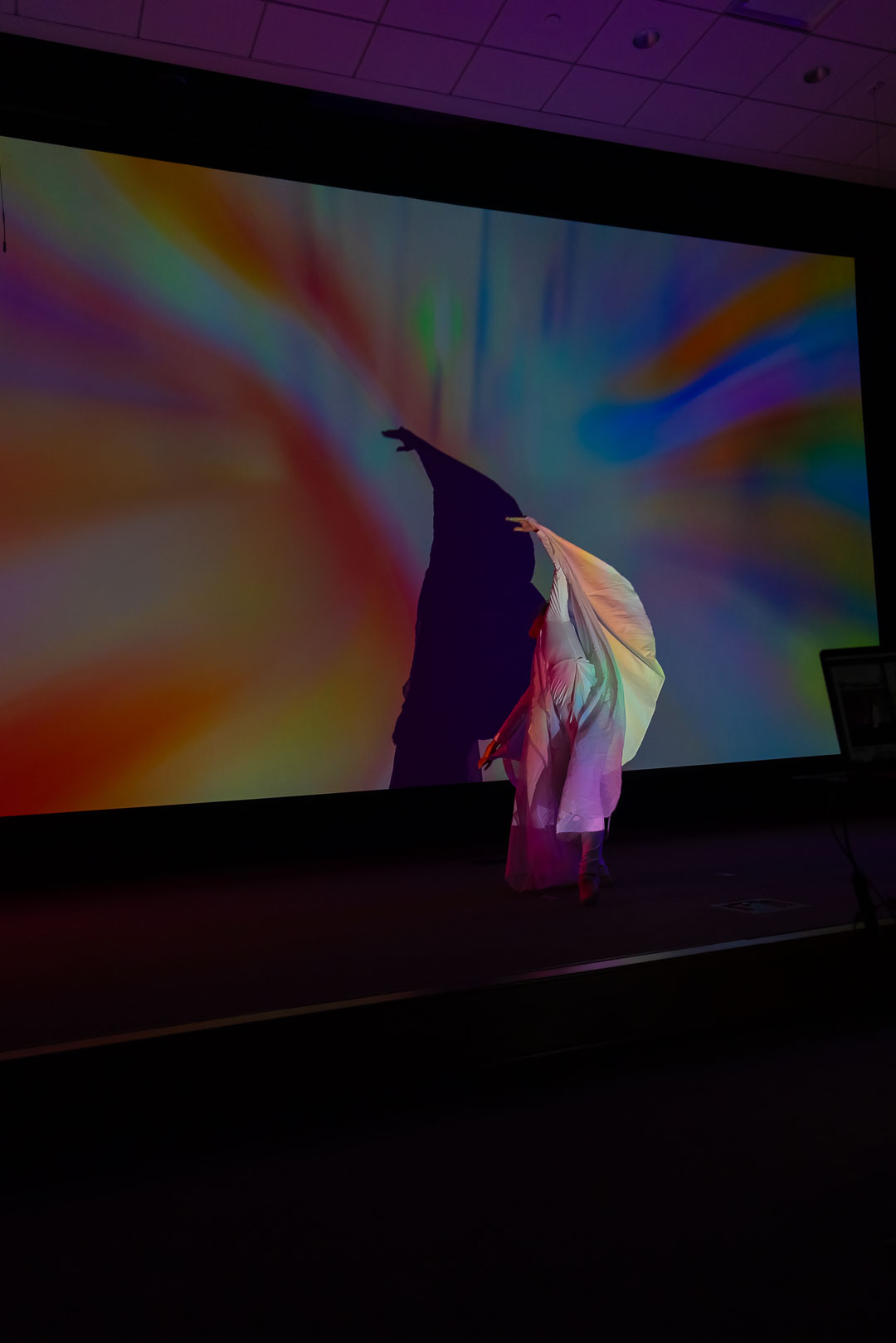
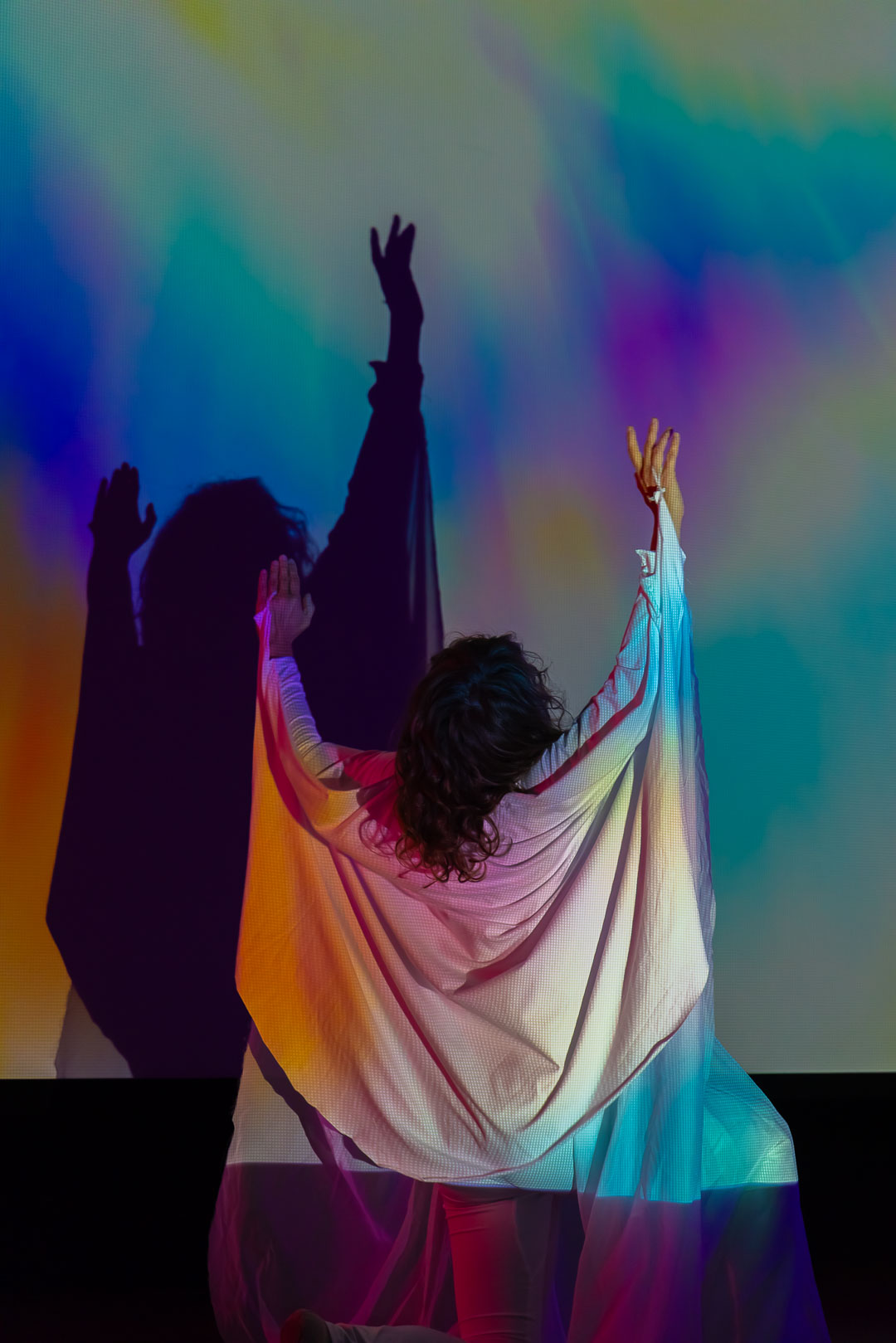
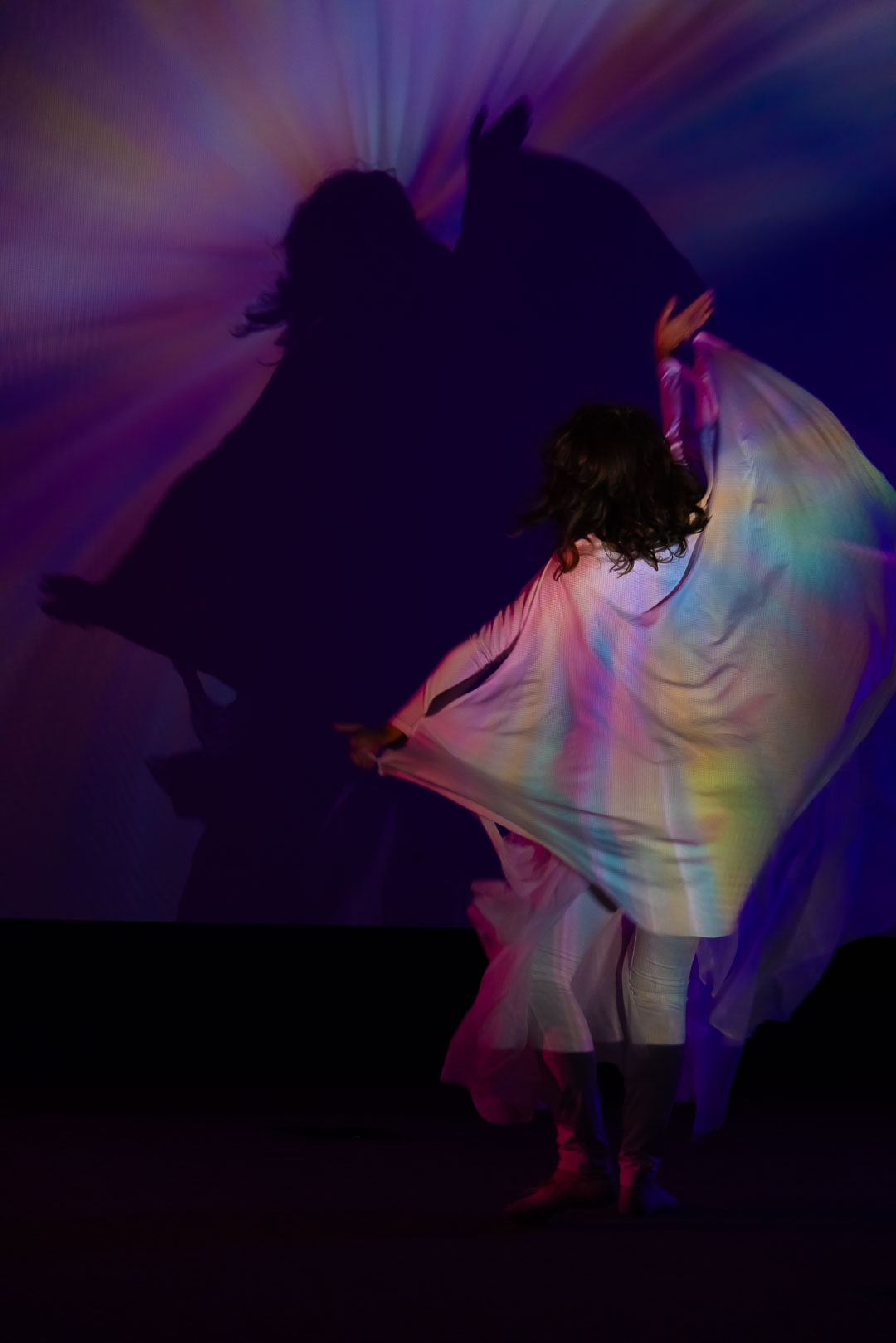
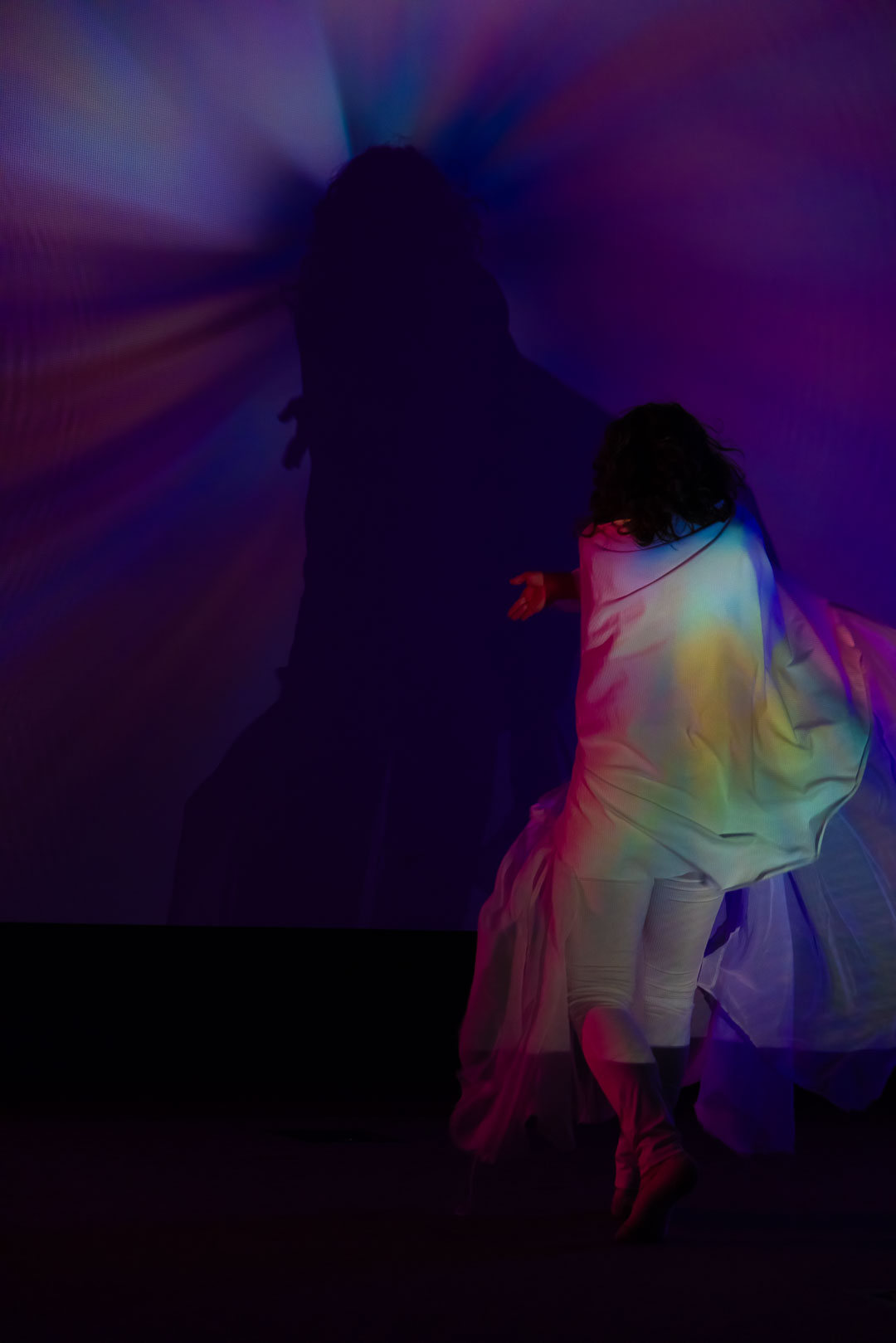
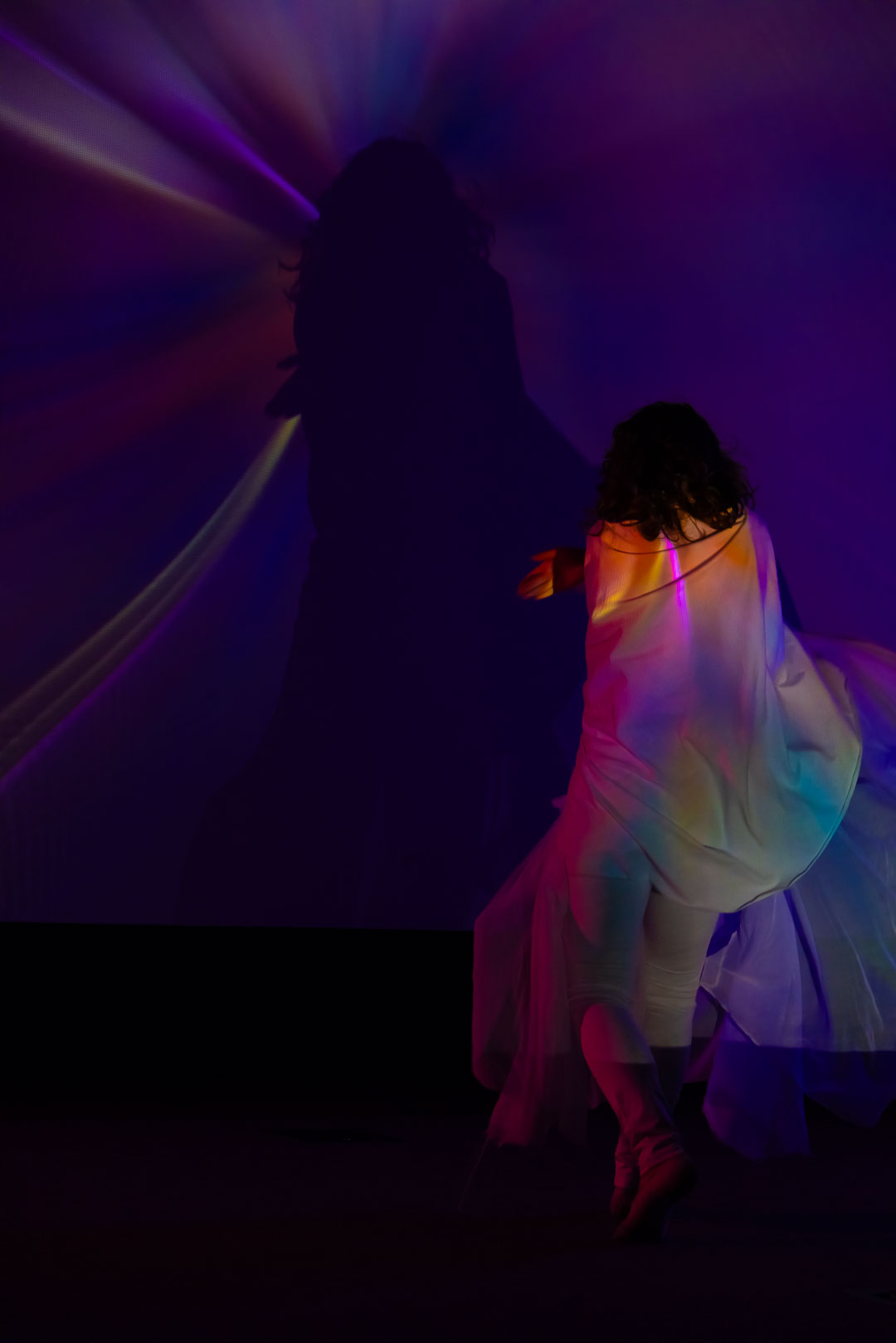
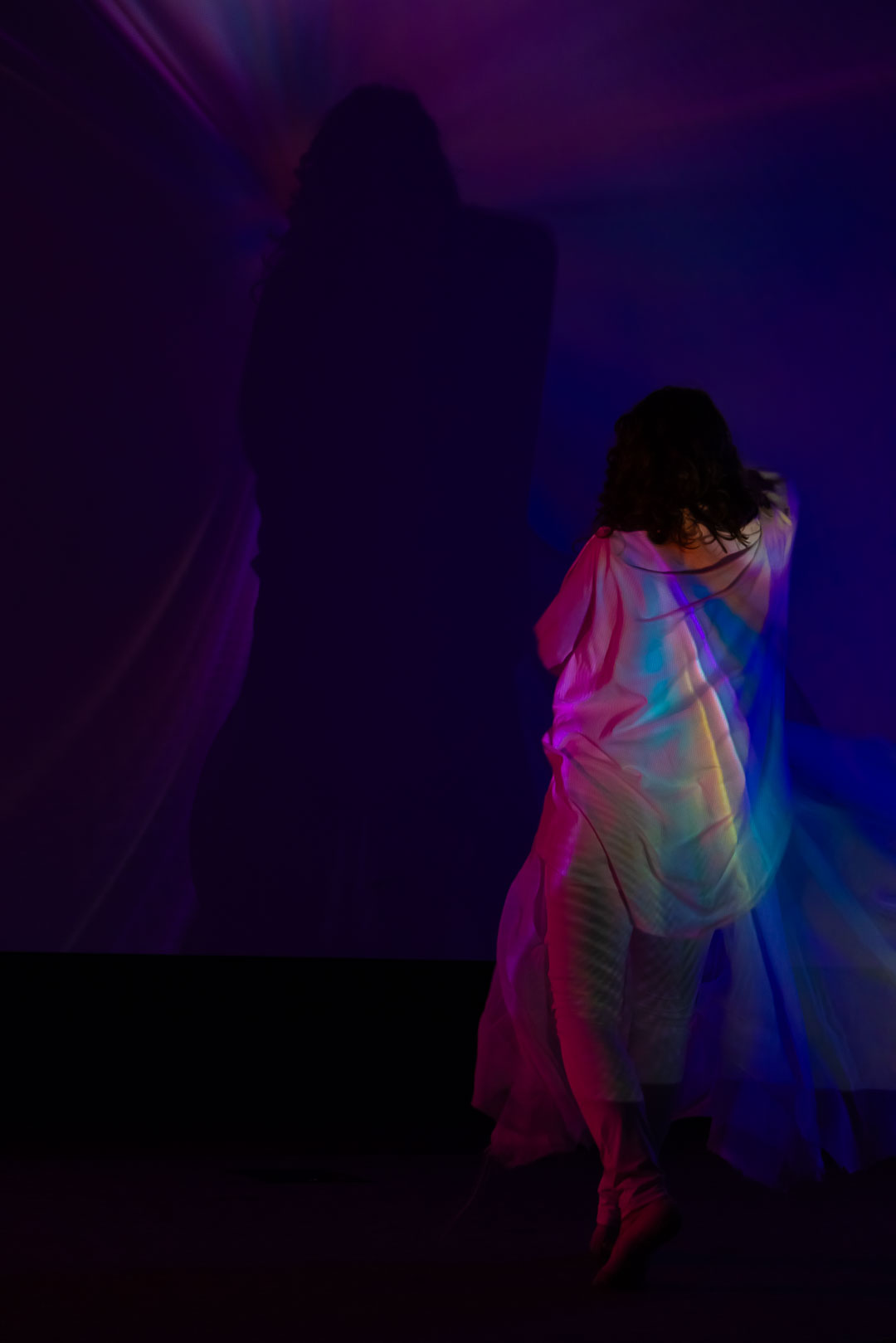
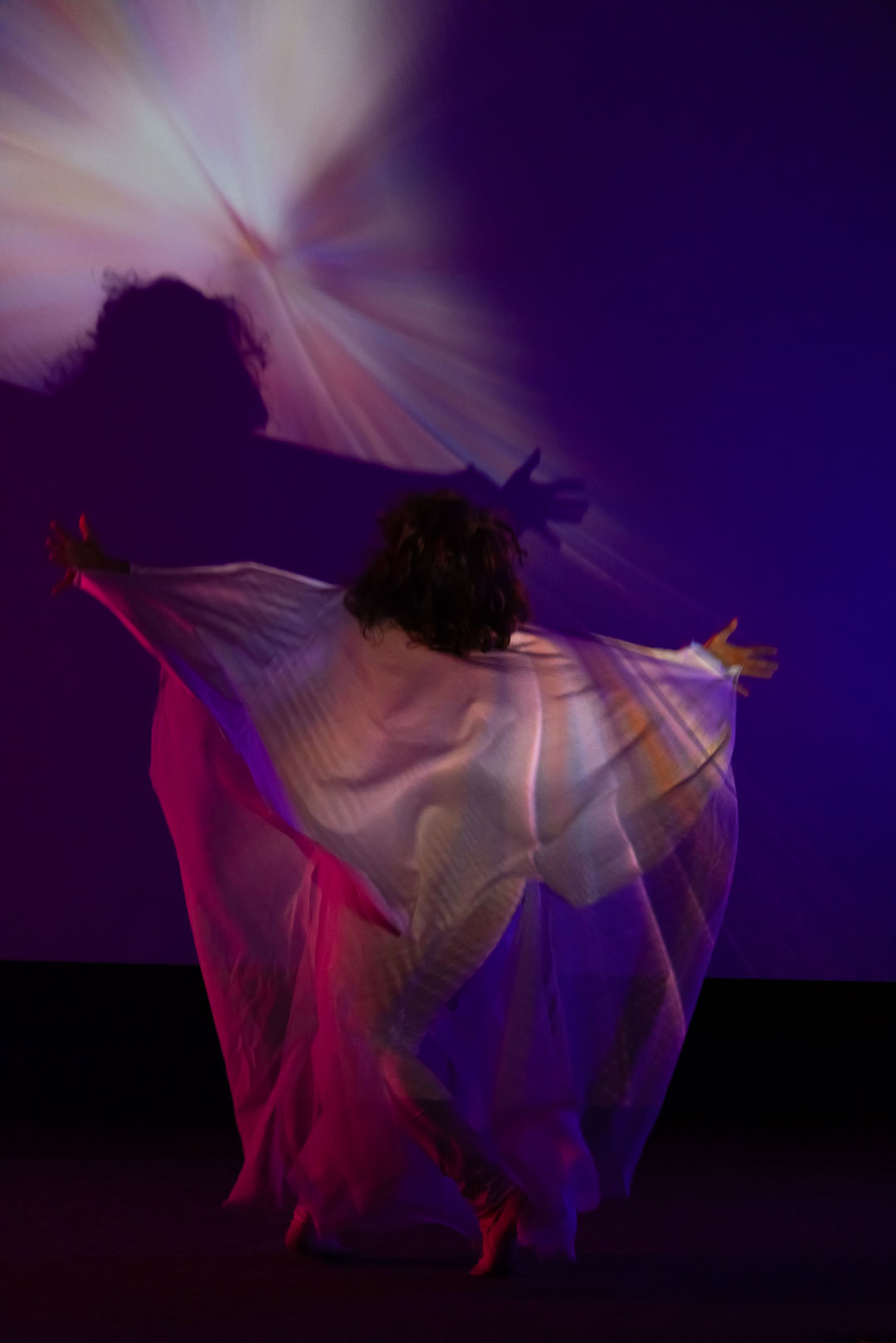
Fixed video projections and blurred live camera feeds merge and diverge throughout the performance, creating a visual poetry that responds intuitively to sound and movement. The dancer’s gestures, both deliberate and ephemeral, serve as ink strokes across an invisible page, animating a space where body, image, and voice are deeply entwined. Cantonese vocalizations, bending between pitches and drifting through quarter-tone glides, echo through the space like distant recollections of language and memory. Exhales and inhales become their own choreography, articulating wonder, disorientation, and longing.
Here, interaction is not merely technological but metaphysical: sound sculpts light, movement disturbs silence, and illusion becomes the only constant. The Convergence offers a portal: a passage through the veil, where phantom forms shimmer into being and vanish before fully arriving.
- Please choose 4K resolution for better experience.
Technical Innovation
The music is composed of both fixed media and live music generated by motion-captured data in Mediapipe that runs in Max. Gates were designed in Max to control the volume of signals from different sounds created by modulations, waveshaping, and granular synthesis. The dancer or composer can choose to change these parameters live to achieve spontaneity and flexibility. The automated system also allows the dancer or user to plan events ahead and run them on a fixed timeline at predetermined volume levels.
To enhance immersivity, the audio format transforms from super stereo in the first movement to an eight-channel (7.1.2) audio output in the second movement. This offers higher complexity in directionality and localization of sounds, creating a more immersive environment for the aesthetic experience.
The live camera feedback undergoes video effects such as color changing through adjustments in gamma, brightness, contrast, hue angle, saturation, vibrance level, temperature, tint, and luminance level. Other video effects used include zoom blur on the X and Y axes, bloom and gloom radius and intensity, bokeh blur with changes in radius, ring amount and softness, box blur, motion blur, crystallization, pointillization, vortex changes on the X and Y axes, pixelation, morph gradient, and distortion.
The audio and visual effect changes in the first and second movements are handled by cues in QLab, which allows fade-ins and fade-outs of different sonic and visual events in a time sequence, offering a well-planned structure for the performance.
Artistic Choice
The noises at the beginning of the piece were made from granular synthesis, describing the pixelated dimensions where reality and imaginative realm meets: the reality not yet disintegrate, while the imaginative realm not yet fully formed. In this dimension, an illusion of reality and imaginative realm intertwined, making it unable to differentiate within, falling into the illusion of phantom and mirage that is dreamy, unrealistic, and distinct.
The visual media is composed of fixed videos that is highly interactive to the audio components and live visual feedback that takes the live video from a phone, sending the live feed to a computer to process the visual effects. The fixed and live video sections intersect among each other in the structure to highlight the audio-visual and visual-movement interactivity. The fixed video at the beginning starts from a centered revolving pattern surrounded by darkness imitates the travelling through the narrow pathway, enclosed by glimpse of purple lights that is interactive to the audio components.
The artistic choices of both audio and visuals are subjected to the above interpretations. The live video components are mostly blurry and/or distorted in fine lines as the process of second movement is describing illusions of phantom without material substance; while the audio components are singing the poem in Cantonese with pitch-bending tones / gliding between quarter tones to create the illusive effects. The audio component also manifests the vocal percussion to create some non-conventional fabrics of sounds adding to the texture, such as “t” / flap, and “s” sound in phonetic. The well-articulated exhaling and inhaling sounds along with the pitch bending express the mixed feeling of bewilderments, astonishment, satisfaction, fear, relieved, assist with the narration of the storytelling. The rapidly inhaling and exhaling sound together with the singing creates the sonic imagination on the laughter of villagers.
Unlike the three-sub-section first movement, the second movement is in through-composed form, which subsequent events follow one another. Both the music and visual media follows this structure to create the narrative journey of fisherman navigating from the entrance of utopia to the encounter and celebration with the descendent of Qing dynasty / the villagers.
The vocal part is in Aeolian mode and the pitch materials are B, C#, D, E, F#, G, A, which is in 2, 1, 2, 2,1, 2, 2 intervallic steps (2 = whole step, 1 = half step). It is not a B minor scale as it did not establish a sense of tonality with the centering of note B, cadential points of V to I, and tonic-dominant relationship. As the pitch materials were unfolded slowly as a confession of feelings, prayers to the enchantment, and melancholic requiem of the perished.
I had the privilege of serving as the composer, audio-visual designer, and director for Phantom of Utopia II: The Convergence, overseeing its development as an extended reality production in the XR Studio. This version featured a layered juxtaposition of real-time live camera feed and generative visual effects that responded dynamically to sound and movement. I was honored to collaborate with dancer Ava Heath, whose performance brought the piece’s physical poetry to life, and with Irina Kruchinina, whose light projection sequence offered a spectral counterpart to the corporeal presence—embodying an alternate, luminous manifestation of the dancer. Their contributions were vital in shaping the dual dimensions of embodiment and illusion at the heart of the work.
Since the original audio formats cannot be played in most public platform, the 5.1.2 video and audio files can be provided upon request.
The piece can be performed live with two camera station setup or pre-recorded in a more immersive extended reality lab.
 Ka Hei Cheng